Showing posts with label mammals. Show all posts

February 21, 2016


part 15:

Nömrög

text by Mathias Putze


( links to previous posts:
1, 2, 3, 4, 5, 6, 7, 8, 9, 10, 11 ,12, 13, 14 )


I had always dreamt to visit the famous and still almost totally unexplored Nömrög SPA in Mongolia’s Far East. No surprise that I was very disappointed when access was denied because of the high fire-risk in 2011 (see here). Meanwhile, I had heard about a program to support tourism in this particular region and hence I was very optimistic when we left for the east again in 2014.

Long time before we headed towards Choibalsan, Abu had worked hard for getting our permits. Nevertheless this was only made possible with the help of Jan Wigsten of Nomadic Journeys and our guide Bolormunkh of WSCC. As usual, there had been loads of paperwork to be done, something that contradicts the idea of improving tourism! A visit to this SPA is still way too complicated!

On 6 June, with our permits in the bag, we visited the headquarters of the SPA and showed our permits. Of course, a new obstacle turned up: we had to get new permits PLUS the head wanted us to hand-over ALL our memory cards after our visit. Ridiculous! Because of language problems (the head didn’t speak sufficient English and Abu’s Mongolian was also not good enough) the local English teacher had to come to the office. For us this meant: wait. We used this “incubation time” to go birdwatching in the vicinity. It turned out that the English teacher was of only little help in regards of translating/interpreting as she spoke almost no English (!), so everything was discussed via “fone” with the help of Abu’s wife. After a while our access was granted and the head just wanted a short report about our visit from us. So we set off to the southeast. Almost.

There was yet another visit to be done: the barracks of the border police. Here we had to show our documents and could use this new and second “incubation time” for shopping and for having lunch. So we did and then, after several hours, we finally could leave Sumber for NÖMRÖG. Nömrög, here we come! Yeah!!!!

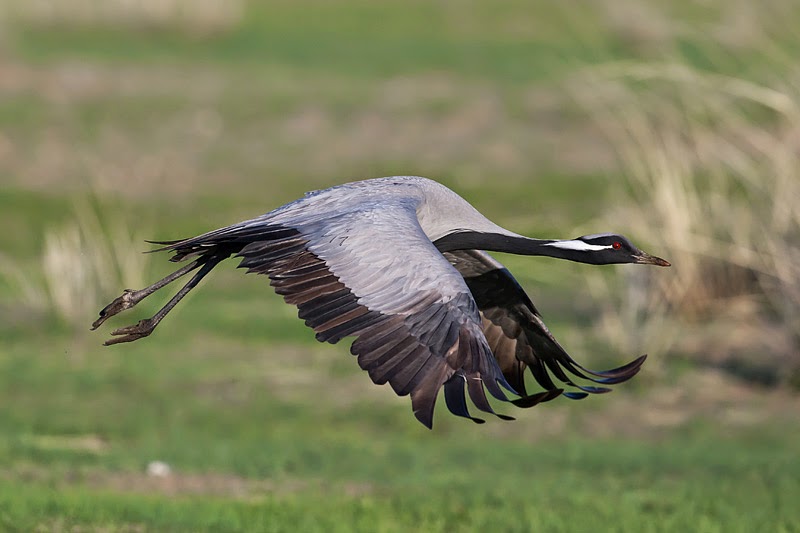
Demoiselle Cranes
south of Sumber, Jun 2014 © M. Putze

A kilometre south of Sumber, at a shallow lake, we could do the first proper birding, alas, only commoner species were seen: a group of 250 Demoiselle Cranes, 30 Common Cranes, quite a lot of Eurasian Wigeons mixed with as many Northern Shovelers, about 70 Black-winged Stilts and 110 Pied Avocets, some of the latter with chicks and a single Eastern Black-tailed Godwit. Not the best start, indeed.

Despite of our time loss in Sumber, we intended to venture as far as possible into the nature reserve. Even for Mongolian standards the tracks were quite bad and we slowly bumped ourselves through rich meadows with abundant flowers and even the occasional bird. The sandy soil hosted clumps of pine forest which nestled between the dunes. There were even bogs and small ponds fringed with willow thickets. Fantastic scenery and then: a really big bird took flight not far from the car. This was a male Great Bustard but else we did not see much until we came across our first beautiful adult male Pied Harrier. Fantastic!


Driving through Nömrog SPA
Eastern Mongolia, Jun 2014© K. Krätzel

Flowering steppe Nömrög, Jun 2014 © A. Schneider

Hemerocallis minor
Nömrög, Jun 2014 © M. Putze

Male Pied Harrier
Nömrög, Jun 2014 © M. Putze

Male Pied Harrier
Nömrög, Jun 2014 © T. Langenberg

Abu decided to camp near a small pine forest and so we did. As soon as we left the car we were welcomed by millions of females which apparently had awaited us. The density of mosquitoes was so high that we walked around while having our dinner instead of using our chairs. These mega-aggressive blood-suckers did not waste time; they landed with their stylet first, ready to suck immediately.

Behind the pines was a boggy area and on the small lake we found a drake Falcated Duck which was accompanied by a few Tufted Ducks and Common Teals. The presence of Black Grouse was revealed by their droppings and we also found the remains of an unfortunate male. We not only saw grouse droppings but also bigger ones, left by a Moose. Fine, but where are they? Not long after we localized a cow with her calf. Unfortunately these magnificent animals decided to take a rest on the ground in the willow thickets before all of us could see them.

Ahh, yes, the birds. Not really exciting species but with Isabelline Shrike, Thick-billed Warbler, Long-tailed Rosefinch, Stejneger’s Stonechat, Siberian Rubythroat and our first Chestnut-eared Bunting seen we could escape the hordes of mosquitoes not without having a couple of moose-beers before total darkness.

Bear & Beer Camp
Nömrög, Jun 2014 © K. Krätzel

Brown Bear
Nömrög, Eastern Mongolia, Jun 2014 © T. Langenberg

Brown Bears
Nömrög, Eastern Mongolia, Jun 2014 © T. Langenberg

Brown Bear watchers
Nömrög, Eastern Mongolia, Jun 2014 © Kirsten Krätzel

Moose
Nömrög, Eastern Mongolia, Jun 2014 © M. Putze

Saker Falcon
Nömrög, Eastern Mongolia, Jun 2014 © M. Putze

In the morning of 7 June we not only saw another female Moose in the same valley; there was a male, too. Near our camp, Saker and Upland Buzzard were attending their respective chicks while Armin went off for searching his favored mammal: Grey Wolf. This time no luck with this one but he and Kirsten and Sönke had more luck with something else. They saw a mother and a cup Brown Bear strolling along the “moose valley”. With the aid of our radios everybody was put on red alert immediately and even our drivers joined for our run to see the bears. Nobody cared any birds until we all had excellent views of the undisturbed predators. This is by no means a common sight in Mongolia which also hosts the pale variant of Brown Bear called Gobi Bear of which only 25 or so roam the desert mountains of Mongolia’s south. There are, of course, Brown Bears in the taiga in northern Mongolia. During this mammal morning we encountered 2 male Black Grouse, a male cristatus Brown Shrike, now even three male Falcated Ducks on the same pond and Japanese Quails while Skylarks and Richard’s Pipits were abundant in the steppe.

After a very happy breakfast we drove (Mongolian Lark, Black-browed Reed Warbler were added to our Nömrög List en route) all the way down to the border police station from where we already could see the other side of the Nömrög river. But we had to accept that crossing it with our cars would be impossible. A Mongolian film crew checked out the situation with one of their 4-wheel-drives but they got stuck 100 m before the river and could not drag out the car without our help. No chance for exploring the other side. Meanwhile we had given our documents for yet another thorough check and during this new “incubation time” we went birding again. A colony of Eastern Rook was found a little to the east and there were about 15 male Black Grouse, Barn Swallows (these were rather pale-bellied which should make them belong to the subspecies mandschurica), at least one lagopodum House Martin, a few Amur Falcons, a pair of Long-tailed Tits feeding, and Great Cormorants. Delight of the day was a male Yellow-rumped Flycatcher which held a territory in a small patch of forest.

Male Eastern Marsh Harrier
Nömrög, Jun 2014 © M. Putze

Male Pallas’s Reed Bunting
Nömrög, Jun 2014 © M. Putze

Stuck in the mud!
Nömrög, Eastern Mongolia, Jun 2014 © A. Schneider

Male Yellow-rumped Flycatcher
Nömrög, Eastern Mongolia, Jun 2014 © T. Langenberg

Then we left the outpost disappointed for driving back to toward Sumber and this time we took another track. In the early evening we set up camp near two small lakes and not long after we had pitched our tents we again saw a moose. Eastern Marsh Harriers were patrolling the reeds, which held lots of Pallas’s Grasshopper Warblers and also Brown-eared Rail, formerly regarded as subspecies of Western Water Rail, which was frequently calling. From the many bushes Yellow-breasted Buntings performed well. Surprisingly, there were three Stejneger’s Scoters on one of the-the bigger one-lake. Later in the evening a Grey Nightjar started calling from the forest. To end the day we had an “anti-mossie beer”, or was it two?

Siberian Roe Deer
Nömrög, Jun 2014 © M. Putze

Female Chestnut-eared Bunting
Nömrög, Jun 2014 © T. Langenberg

Male Chestnut-eared Bunting
Nömrög, Jun 2014 © T. Langenberg

Already in the night it had started to rain, sometimes really hard. So in the morning of 8 June everything was soaking wet. This could not prevent us from birding but after a few hours walking through the high wet vegetation we gave up and left for Sumber. The buntings were still active and we tried our luck on the gorgeous Chestnut-eared Bunting with varying success. It was still raining hard all the way back to Sumber but at least we came across a pair of Pied Harrier and flushed (not intended) several Great Bustards.

Sliding back to Sumber
Nömrög, Eastern Mongolia, Jun 2014 © Kirsten Krätzel

To conclude, even with all the superfluous hassle of obtaining permits and several timing consuming permit and passport checks, even without reaching beyond Nömrög River, even with all the biting flies, to see one of the most unspoiled and-as very important as very rare-livestock-free parts of Mongolia is worth the effort. Thank You, Jan! Thank You, Boogii!

December 13, 2015


part 13:

Along the Khalkh gol
north of Sumber

text by Armin Schneider


( links to previous posts: part 1, 2, 3, 4, 5, 6, 7, 8, 9, 10, 11 ,12)


Sumber north camp, Jun 2014, © K. Krätzel

Fantastic view from inside Matze’s tent
Sumber north camp, Jun 2014, © M. Putze

Excellent birding from our elevated site above the valley!
Sumber north camp, Jun 2014, © K. Krätzel

After another shopping trip to Sumber on 3 June, Abu had the idea to camp at a site north of the village. A couple of kilometers later we made a first attempt to find the right place but instead of this we located our first singing Chinese Bush Warblers. Because of the high density of mosquitoes down in the valley and the low density of birds we chose a campsite above the eroding bank of the Khalkh gol (Khalkh river). Here we settled down for the next few nights (3 to 6 June and again from 9 to 10 June). Although not totally mosquito-free, this site was well chosen not only for its beautiful settings but also for a set of first class bird species (see part 12: Baikal Bush Warbler).


Eagle Owl
Sumber north camp, Jun 2014, © T. Langenberg

Chinese Bush Warbler
Sumber north camp, Jun 2014, © A. Schneider

Chinese Bush Warbler
Sumber north camp, Jun 2014, © T. Langenberg

Even before the camp was ready for occupation, two Eagle Owls jumped from the rocky edge below our camp ground. To us it seemed that their large flight distance could be a hint for a more intense hunting activity in this area. The birds kept a distance of more than 150 meters despite the high probability that they had their owlets in the area (we did not find their nest, though).


Black-browed Reed Warbler
Sumber north camp, Jun 2014, © T. Langenberg

Black-browed Reed Warbler
Sumber north camp, Jun 2014, © T. Langenberg

Black-browed Reed Warbler
Sumber north camp, Jun 2014, © M. Putze

Radde’s Warbler
Sumber north camp, Jun 2014, © T. Langenberg

Siberian Blue Robin
Sumber north camp, Jun 2014, © T. Langenberg

Lanceolated Warbler
Sumber north camp, Jun 2014, © A. Schneider

During our stays we explored the area and the team found Black-browed Reed Warblers (just arrived and singing all day!), Pallas's Grasshopper Warblers, Thick-billed Warblers, Siberian Rubythroats, Daurian Starlings, Yellow-browed and Radde’s Warblers, one territory of a Lanceolated Warbler, 2 or 3 territories of Lesser Whitethroat and a Siberian Blue Robin trying to hide inside a bush. Furthermore, we found at least 6 territories of Chinese Bush Warbler as well as 3 Black-naped Orioles and a Yellow-breasted Bunting which was singing from the reeds. One day (4 June) we spotted a migrant White-throated Needletail which was seen by most of us thanks to the use of radio! A singing Brambling was present in the willows all the time.


Black-naped Oriole
Sumber north camp, Jun 2014, © T. Langenberg

Dark-sided Flycatcher
Sumber north camp, Jun 2014, © M. Putze

Common Cuckoo
Sumber north camp, Jun 2014, © M. Putze

Singing Daurian Starling
Sumber north camp, Jun 2014, © M. Putze

2cy male Yellow-breasted Bunting
Sumber north camp, Jun 2014, © A. Buchheim

It was not only that we had to celebrate the birthday of one of us during our stay at the camp, with lots of shashlik and drinks, the birds were responsible for repeated celebrations, too:

On 4 June Armin started another expedition and in an “African Savanna”-like habitat and he accidentally came across a bird he was not familiar with. The unknown bird was shouted out via radio and identification help was on its way soon after. What it turned out to be will be posted next!


Siberian Roe Deer
Sumber north camp, Jun 2014, © M. Putze

Would you believe it?
Celebrating without beer!
Sumber north camp, Jun 2014, © M. Putze


January 3, 2015


part three:

The way to Choibalsan

text by Abu

( links to previous posts: part 1, part 2 )


The metal box which failed to connect with the Beijing-UB flight,
Frankfurt/Main Airport, Germany, May 2014, © Mathias Putze

Never enough beer, right?
UB, May 2014, © Mathias Putze

One or two trays of vodka?
Not only beer was on our shopping list!
UB, May 2014, © Kirsten Krätzel

Tuul River in UB, from above,
May 2014, © Mathias Putze

One bag, actually the metal box containing our walk-in traps, did not arrive with us, and that gave us some time to go birding along the Tuul River in UB on 27 May. As usual, this was not done before our shopping had been completed. And we bought more than beer only! Most of our provisions for the entire trip were on our shopping list and it took quite a while to get everything. In the evening we had a nice dinner at one of our favorite restaurants. While I went to the airport, the group visited the Tuul River for a few hours of birdwatching. Between the many green bushes we saw the standard species like Lesser Spotted Woodpecker, Azure Tit, Long-tailed Rosefinch, Steppe Eagle, Black Stork, Citrine and Grey Wagtails, some stunning male Daurian Redstarts and a White-crowned Penduline Tit, which was attending a yet unfinished nest, and, much appreciated because flying rather low, a Booted Eagle. Then, once the box finally had arrived, it was fetched from the airport after a lengthy discussion with the customs officers and we teamed up again to set off for the east on 27 May.


Tuul River in UB,
May 2014, © Kirsten Krätzel

Female Long-tailed Rosefinch
UB, May 2014, © Mathias Putze

Male Long-tailed Rosefinch
UB, May 2014, © Mathias Putze

Male White-crowned Penduline Tit
UB, May 2014, © Thomas Langenberg

Booted Eagle
UB, May 2014, © Thomas Langenberg

Race horses on a truck between UB
and Öndorkhan, May 2014 © Mathias Putze

From UB to Öndorkhan we drove on an asphalt road and hence we did not see much from the fast driving car. It was obvious that Nadaam, one of the two major events in Mongolia, was near. Many race horses got a free ride to UB. We drove until late afternoon and then started looking for a nice spot to pitch our tents. The first night out we spent not far from Öndorkhan at a very small poplar plantation and an even smaller stream. Birds we logged during this first part of our journey were the mega abundant Père David’s Snowfinches, which uses the similar abundant holes of the likewise abundant Brandt’s Voles for breeding, Mongolian Lark, Asian Short-toed Lark, Richard’s Pipit, Citrine, Yellow and Grey Wagtails, lots of Mongolian Buntings aka Pallas’s Reed Bunting ssp. lydiae, Northern Lapwings, Common Sandpipers, 3 Common Shelducks, Common Tern (fascinating that it was checking out a small streamlet like this), Demoiselle Crane, several Amur Falcons in the poplars (but unclear whether they were breeding here) and a Steppe Eagle. A Corsac’s den full of playful youngsters was a nice bonus near the camp.


The streamlet near Öndorkhan,
May 2014 © Kirsten Krätzel

Young Corsac Fox near our first campsite,
near Öndorkhan, May 2014 © Thomas Langenberg

Demoiselle Crane
near Öndorkhan, May 2014 © Mathias Putze

Common Tern
near Öndorkhan, May 2014 © Mathias Putze

Asian Short-toed Lark
near Öndorkhan, May 2014 © Mathias Putze

Mongolian Lark
near Öndorkhan, May 2014 © Mathias Putze

Mongolian Lark
near Öndorkhan, May 2014 © Thomas Langenberg

Our camp near Öndorkhan,
May 2014 © Kirsten Krätzel

Tracks always come in groups,
between Öndorkhan and Choibalsan.
May 2014, © Mathias Putze

After a quick check of the morning birdlife we continued our eastbound migration. The asphalt road had ended which meant that we could only drive at a much reduced speed. So on this lag on 28 May we drove on tracks, which is still the most common type of road in the countryside. This particular stretch of the road was in very bad condition with plenty of deep holes, some even filled with water. En route birdwatching yielded a large group of 34 Eurasian Black Vultures and the standard suspects like Common Skylark, Upland Buzzard, Père David’s Snowfinch plus others were also recorded again. Further we had fleeting views of small but fast running groups of Mongolian Gazelle. Despite our slow pace, Choibalsan (CB) was reached in the early evening. For our second expedition night we chose to stay near the airport on the banks of the Kherlen River which is our standard site in/near CB (see here, Eastern Specialties trip). Surprisingly, there were not many birds in the bushes along the river but the photographers somehow managed to get decent shots of some of the few species around. The few birds around impressed with their songs: Siberian Rubythroat, Two-barred Warbler, Arctic Warbler (not an impressive song, agreed!), Oriental Reed Warbler and Black-faced Bunting. Highlight at the camp was a pair of Yellow-rumped Flyctachers.


Eurasian Black Vulture
between Öndorkhan and CB,
May 2014 © Thomas Langenberg

Chinese Spotbill (Duck)
CB, May 2014, © Mathias Putze

Our camp at the Kherlen River,
CB, May 2014 © Kirsten Krätzel

Black-faced Bunting
CB, May 2014, © Mathias Putze

Isabelline Wheatear
CB, May 2014, © Thomas Langenberg

Arctic Warbler
CB, May 2014, © Thomas Langenberg

Kherlen River near CB,
May 2014, © Kirsten Krätzel

The next day we crossed a sea of Stipa grass to reach the incredible Buir Nuur. Watch out and read more next!


Young Corsac Fox, watching out!
near Öndorkhan, May 2014 © Mathias Putze