July 31, 2011

Some Eastern Specialities and More - Tour 2011
Part two: Going east to Ikh Tashgai Nuur

Pair of Common Raven, main road to the east,
May 2011, © M. Putze

On 15 May we drove to the east until it got late. Our first camp was on the shores of Gurmijn Nuur near the city of Bayan Ovoo. Virtually the first birds we saw there were two adult Relict Gulls which had been foraging on the shore. They flew out to the middle of the lake but returned next morning.

Adult Relict Gulls, Gurmijn Nuur, May 2011, © A. Pennekamp

We checked the waterfowl in the fading light until it got too dark. Best birds we could find were a pair of Falcated Duck, and seeing 150 Stejneger's Scoters was also impressive. On the shore we had a White Wagtail of the subspecies M. a. ocularis and waders were on the move as demonstrated by incoming flocks (from the south) of Pied Avocet and Common Greenshank. We checked the lake again next morning and found the first “goodie”: a drake Greater Scaup, a species that has been recorded in Mongolia probably less than 10 times before!

Gurmijn Nuur, May 2011, © A. Buchheim

In the afternoon of 17 May we arrived in Choibalsan, the only larger city in the east.

Nice price at the gas station, Choibalsan,
15 May 2011, © M. Lindemann

Here we camped at the Kherlen River which has some higher vegetation. Brambling and Eurasian Siskin were still around, while Amur Falcon, Pallas’s Warbler and Taiga Flycatcher had arrived already. We remained at the spot another day (song of White’s Thrush in the early morning) and had a flock of migrating Pacific Golden Plover, and in the evening loads (= several hundred) of Yellow Wagtails came in to sleep in the willows.

4 guys being impressed by Uli (count the beer cans!),
Kherlen Gol, May 2011, © M. Lindemann

Male Amur Falcon, Kherlen Gol, May 2011, © M. Putze

Richards Pipit is very common in the lower lying areas
of Mongolia. Kherlen Gol, May 2011, © M. Putze

Mongolian Lark is also rather common wherever there
is higher grass. Kherlen Gol, May 2011, © M. Putze

On 18 May we moved on eastwards. The area east of Choibalsan is very flat and treeless but during a brief stop at the border police barracks (we needed to register there as we were entering the sensitive region along the Chinese border) Manfred spotted an unfamiliar bunting. This turned out to be our first Yellow-throated Bunting for the trip, a stunning male. As it had lightly damaged plumage we thought it would be our only observation of this species, which was regarded as accidental. So we asked for permission to take pictures, which was kindly granted. Very likely, these are the first photos ever of this species taken in Mongolia!
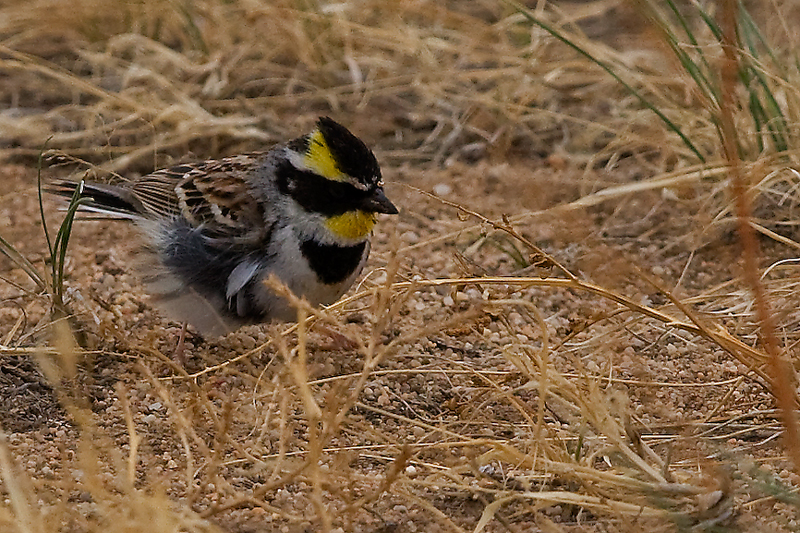
Male Yellow-throated Bunting, Menengijn Tal border station,
18 May 2011, © Andreas Buchheim

Male Yellow-throated Bunting in flight, Menengijn Tal
border station, 18 May 2011, © M. Putze

Although we had expected to see large numbers of Mongolian Gazelle during our cruise through Menengijn Tal, the biggest group was just over 200 individuals. Apparently many had left these plains. This was rather surprising as the region seemed to be not overgrazed at all (almost no people live in Menengijn Tal).

Mongolian Gazelle near Choibalsan, May 2011, © M. Putze

Nevertheless, finding a good reed bed (it was the beginning of songbird-migration!) was our task for today so we drove along the chain of lakes south of the plains. Unfortunately they all had dried up and no reed beds were left. So we ended up at a dry lake (already quite close to Ikh Tashgai Nuur) which had much degraded reeds. Here we spent the night.

Much degraded reeds and its degraders, west of
Ikh Tashgai Nuur, May 2011, © A. Buchheim

On May, 19th we finally arrived at birder’s heaven: Ikh Tashgai Nuur. Whether we found our “sought-afters” or not will be reported next… so stay tuned!

July 24, 2011


male Ochre-rumped Bunting, Ikh Tashgai Nuur, © A. Buchheim

This year’s trip brought us to Mongolia’s Far East where we hoped to see some “Eastern Specialties”. But: Statistics first!

duration: 3 weeks for Manfred and Alfons, 4 weeks for Thorsten and 5 weeks for the remaining three.
mileage: 2440 km
species total (5 weeks): 234
first records for Mongolia: 3
second records for Mongolia: 1
days without Common Raven logged: 11 consecutive in the east
days without beer: 2 (but not at Ikh Nart!)

Warm-Up

As our warm-up we went to the Tuul gol (Tuul River) below Songijno Khairkhan Uul where our target species was Azure-winged Magpie. This area has some riparian forest left and the species is regularly (but not always) seen here. In the morning of May, 14th we met Brian Watmough, who is always interested to go out birding and then we drove the 25 km to the west of Ulaanbaatar.

heavily grazed (no understorey) riparian forest below
Songijno Khairkhan Uul, May 2011, © U. Winkler


Hawfinch below Songijno Khairkhan Uul, May 2011, © M. Putze


Black-eared Kite below Songijno Khairkhan Uul,
May 2011, © M. Putze

In the beginning the group saw other birds like Wryneck, Hawfinch and White’s Thrush but then the first blue magpie was spotted. This one turned out to be part of a party of 16 birds which disliked the presence of their bigger relatives allowing us to observe them well for more than 10 minutes.

watching magpies below Songijno Khairkhan Uul,
May 2011, © U. Winkler

dispute between two magpies
(yes, the right one is not a Black Grouse!),
below Songijno Khairkhan Uul, May 2011; © M. Putze

some of the 16 blue ones below
Songijno Khairkhan Uul, May 2011, © Mathias Putze

After having checked the UB-Ponds (disappointing) we returned to the capital by noon and went shopping in the afternoon. The next day saw us on the road to the east …

More to come!

June 24, 2011

Longest twitch in Mongolia 
 
Brian Watmough, 22 June 2011
 
Just completed the longest twitch in Mongolia, 392 kilometres round trip in under 8 hours. Abu [Andreas Buchheim] sent me a text at 12:30 saying there were 3 Siberian Cranes 190 kilometres east of UB, on a small reservoir just a kilometre north of the main road. I realised I had no meetings in the afternoon, so the choice was finishing a report or 3 cranes. Just 5 hours later I was looking at 3 immature Siberian Cranes. My colleagues were bemused that I should make such an effort just to see three birds.


immature Siberian Cranes, c. 60 km E of Baganuur,
22 Jun 2011. © A. Buchheim
 

Siberian Cranes and a Demoiselle Crane, E of Baganuur,
22 Jun 2011. © A. Buchheim

May 25, 2011

Please look out for flagged
shorebirds from Thailand

Over 10,000 waders have been flagged and banded in Thailand by the Department of National Parks, Wildlife and Plants Conservation during 2007 to the present under a national programme for wild bird surveillance. This has resulted in well over 100 foreign resightings of Thai-flagged waders, most from the coasts of E and NE China, with others from Malaysia, Singapore and Indonesia.


cannon-netting shorebirds. © Wicha Narungsri


A handful of Broad-billed Sandpipers. © Pinit Saengkaew

Roughly half of all waders flagged are Greater and Lesser Sand Plovers, for which Thailand holds internationally important wintering populations. As yet, we have yet to receive any resightings of either species in any country to the north of Thailand. Since the race(s) of Lesser Sand Plover that winter in Thailand are in the “atrifrons group” (probably mostly C. m. schaeferi), which breeds in Central Asia [along with Greater Sand Plover], this lack of resightings is understandable, especially given the huge land areas and the paucity of observers in that region.


Lesser Sand Plover © Philip Round/The Wetland Trust


© Pinit Saengkaew


© Pinit Saengkaew

We appeal to observers making birding trips in Mongolia, western China, and other Central Asian countries in the summer months to look carefully at any waders they see in order to search for birds bearing coloured leg-flags. Besides sand plovers there are other shorebirds bearing Thai flags that migrate overland and/or breed in Central Asia (e.g. Common Redshank) that should be looked out for.


leg-flagged Common Redshank, Pak Thale, Thailand. © Christopher Taylor


Department of National Parks ringing team. © Pinit Saengkaew

Thailand uses a black flag placed above a green flag. It is important to record both the shape of the flag (oblong or triangular), and whether the flags are on the right or left leg. (The flags may be both on the tibia, or with the black flag on the tibia and the green flag on the tarsus–precise position of the flags on the leg is not relevant to the resighting).

We should be most grateful for any reports of flagged waders. Resightings of flagged birds may be reported via the Australasian Wader Study Group web-page using the form provided: click here or direct to Ms. Duangrat Phothieng, Department of National Parks Wildlife and Plants Conservation, Bangkok, Thailand: pothieng at hotmail dot com

May 1, 2011

Birding the Gobi, late April

Brian Watmough

It’s the second half of April and the numbers of migrant birds are increasing by the day. I was in Dalanzadgad (DZ) the capital of Umnogobi aimag (South Gobi Province) for a conference but managed to spend a few hours birding with Tumendelger (Tume), local birder and photographer. The trees in the centre of town regularly attract migrants but on early morning visits on 21, 22 and 23 April I only saw Daurian Redstart (2), Black-throated Thrush (4), Brambling (1) and Common Chaffinch (2). On 22nd Tume drove us to DZ Pond, a small lake and marsh at southern edge of town. There were 5 Common Pochard, 3 Tufted Duck and a single female Common Goldeneye on the water, Little Ringed Plover feeding on the shore with flocks of Water Pipit, a Desert Wheatear was singing and two White Wagtails flew overhead. From there we drove to the tree nursery on the south of town where we saw 3 male Daurian Redstart and a Siberian Accentor.

Common Shelduck Gobi, Mongolia, April 2011 © Tumendelger 

The rest of the morning was in meetings but in the afternoon we drove to small salty lakes some 30 km to the east of DZ. Here there was a good variety of waterfowl including 2 Falcated Duck and 3 Whooper Swans. When we returned to DZ around dusk a flock of 14 Black Kites was circling overhead looking for a safe roosting place, and were joined by flock of 40 Daurian Jackdaws and 6 Amur Falcons.

Lake in the Gobi, April 2011 © B. Watmough

Lake in the Gobi, April 2011 © B. Watmough

Species list
Whooper Swan (3), Common Shelduck (25), Ruddy Shelduck (10), Gadwall (5), Falcated Duck (2), Eurasian Wigeon (55), Northern Shoveler, Northern Pintail (10), Common Pochard (30), Tufted Duck (15), Common Goldeneye (10), Grey Heron (3), Great Cormorant (2), Black Kite (20), Hen (Northern) Harrier (1 ringtail), Eurasian Sparrowhawk (1), Northern Goshawk (1), Amur Falcon (6), Eurasian Coot (1), Pied Avocet (18), Northern Lapwing (3), Little Ringed Plover (20), Kentish Plover (4), Green Sandpiper (2), Mongolian Gull (2), Asian Short-toed Lark, Crested Lark (1 by ger), Eurasian Skylark, Horned Lark, Black-throated Thrush (12), Daurian Redstart (6), Northern Wheatear (1), Desert Wheatear (3), Siberian Accentor (1), White Wagtail (2), Water Pipit (30), Brambling (1), Common Chaffinch (2), Mongolian Finch (15).


PS Tume took this picture earlier this month on steppe 70km north of DZ

McQueen's Bustard, Gobi, Mongolia, April 2011 © Tumendelger

April 2, 2011

Ducks in the Gobi


Ferruginous Ducks, Gobi, 30 Mar 2011

Purevsuren Tsolmonjav sent these photos of a migrant waterfowl resting in a tiny (c. 60 x 30 m) pond at the Oyu tolgoi mine in the South Gobi province.


Mining pond in the South Gobi Province

On 29 March 2011 he observed together with Dorjderem Sukhragchaa 4 Eastern Spot-billed Ducks (or Chinese Spot-billed Ducks) Anas zonorhyncha.


Eastern Spot-billed Ducks, Gobi, 29 Mar 2011

On 30 March there were 2 Ruddy Shelducks, 1 Eurasian Teal, a pair of Gadwall, and 4 male Ferruginous Ducks on the pond!


Gadwalls and Eurasian Teal, Gobi, 30 Mar 2011

Thank you Puujee for sending these photos, and keep up the good work!

March 28, 2011

White-cheeked Starling


The White-cheeked or Grey Starling (new name Poliopsar cineraceus, old name Sturnus cineraceus) is a rather common breeding visitor to northern Mongolia. For example, it can easily be observed in the region around Ulaanbaatar. Often rather large flocks gather at the famous “UB Ponds” (Omchij nuur).


Purevsuren Tsolmonjav took these photos of a migrant in an area with some Siberian Elm Ulmus pumila trees in the South Gobi Province on 27 March 2011.

March 23, 2011

Mongolia revokes decision
to allow leopard hunting for science

ULAN BATOR, March 23 (Xinhua) -- The Mongolian government had revoked a decision it made earlier this month to allow foreigners to hunt leopards for scientific purpose, local media reported Wednesday.

Mongolian Environment and Tourism Minister L. Gansukh cancelled the permission to kill four leopards for scientific purpose this year, after meeting researchers and representatives of non-government organizations to discuss the issue.

The researchers opposed the decision made by the cabinet on March 2. They said genetic research and other modern technologies made it possible to do scientific research without killing the highly endangered species.

The decision to allow four leopards to be hunted incurred opposition worldwide. Snow Leopard Network, a major organization aimed at protecting the species, sent a written appeal to the government, urging it to reverse its decision.

The Convention on International Trade in Endangered Species of Wild Fauna and Flora, an international agreement which entered into force in 1975 to protect wild animals and plants, has listed the snow leopard as one of species threatened with extinction which are or may be affected by trade.

Snow leopards normally live between 3,000 and 5,500 meters above sea level in the rocky mountain ranges of Central Asia. According to a survey conducted in 2009 and 2010, there are more than 1,200 leopards in Mongolia.

above from:
English.news.cn 2011-03-23 20:45:12; Editor: Fang Yang
http://news.xinhuanet.com/english2010/sci/2011-03/23/c_13794720.htm


A big thank you to all who signed the petition against the hunting of Snow Leopards!

March 22, 2011

Snow Leopards
to be hunted in Mongolia!?


The Mongolian Government has recently proposed the legal hunting of up to four – and possibly many more – Snow Leopards in 2011, for “research”.

Sign this petition and join with Panthera in pledging your support for Snow Leopards, and telling the Mongolian government that all information required to conserve these cats is obtainable through non-lethal means.


© Steve Winter/National Geographic

Today 3,500–7,000 Snow Leopards remain across 12 range states in Asia. They are listed as Endangered and are in decline in many parts of their range.

Panthera and our partner, the Snow Leopard Trust, are conducting the longest and largest ever Snow Leopard study, located in the Tost mountains in Mongolia. Our combined efforts are resulting in the most data ever collected on this rare and elusive species; and these data are being used to help better protect Snow Leopards long into the future. Hunting endangered Snow Leopards will in no way aid research efforts.

Those who have worked with the Mongolian Government to establish and implement sound biodiversity conservation policies have been deeply shocked and disappointed to hear of these plans.

Click here to read the letter by Panthera’s Snow Leopard experts Dr. George Schaller and Dr. Tom McCarthy to the Ministry of Nature, Environment and Tourism requesting that the decision to permit the hunting of Snow Leopards be reconsidered.

Read more about Mongolia’s proposal to hunt the Endangered Snow Leopard here. And about Panthera’s Snow Leopard Conservation Program


Observations from the Gobi
February & March 2011

Purevsuren Tsolmonjav

The research and monitoring team of the environmental department of Oyu Tolgoi LLC has started to conduct wildlife observation around Oyu Tolgoi license area in the Gobi on a monthly basis.


Asian Short-toed Lark. © Purevsuren Tsolmonjav

During the first survey on 19 February 2011 a total of 12 species of birds were recorded:

Pallas’s Sandgrouse (many), Common Raven (many), Common Magpie (many), Mongolian Ground-jay (8), Wallcreeper (1), Siberian Accentor (many), Common Redpoll (many), Chaffinch (2), Little Owl (1), Bearded Vulture (1), and Cinereous Vulture (1).


Common Redpoll. © Purevsuren Tsolmonjav


Mongolian Finches. © Purevsuren Tsolmonjav


Mongolian Finch.© Purevsuren Tsolmonjav

During the second survey on 19 March 2011 a total of 16 species of birds were recorded:

Pallas’s Sandgrouse (many), Common Raven (many), Common Magpie (many), Chukar (many), Mongolian Ground-jay (2), Daurian Jackdaw (many), Siberian Accentor (many), Common Redpoll (many), Chaffinch (1), Asian Short-toed Lark (many), Mongolian Finch (many), Güldenstadt’s Redstart (1), Godlewski’s Bunting (many), Eurasian Tree Sparrow (many), Horned Lark (1), Cinereous Vulture (1).


Güldenstadt’s Redstart. © Purevsuren Tsolmonjav


Güldenstadt’s Redstart. © Purevsuren Tsolmonjav


Mongolian Ground-jay. © Purevsuren Tsolmonjav

March 18, 2011

First Chinese re-sighting of a
Whooper Swan marked in W Mongolia


Whooper Swan, Moguhu Lake, Xinjiang, China,
March 2011. © Jiansheng Liu &  Jie Xu

A Whooper Swan marked with the blue neck collar “OT51” by a Wildlife Science and Conservation Center of Mongolia Mongolian Academy of Sciences team at Airag Lake (48°54’ N, 93°23’ E) in western Mongolia on 29 July 2010 has been photographed in Xinjiang, western China on 13 March 2011. The information came from Mr. Jiansheng Liu and Mr. Jie Xu , who saw the swan together with about 100 other swans at Moguhu Lake (44°26’54.69 N, 85°54’26.98, altitude 391 m). Moguhu Lake is a waste lake near the big city of Shihezi.


Location of capture and re-sighting of the Whooper Swan.
Map © Google Earth, 2011

This information was communicated by Prof. Ma Ming from the Xinjiang Institute of Ecology and Geography of the Chinese Academy of Sciences. Many thanks to Prof. Ma Ming and the observers, Mr. Jiansheng Liu and Mr. Jie Xu.

You can learn more about our waterbird marking efforts from the Wildlife Science and Conservation Center of Mongolia website.