August 10, 2011

Some Eastern Specialities and More - Tour 2011

Part 4: When bad luck turns – the 1st first record

“No way to Numrog” said the officer in the afternoon of 22 May. We were in the featureless village of Sumber, which does not even have a public bath house and could not get further south than this. “The fire-risk is too high because of the dry and high grass” we were informed. Obviously we had to adjust our plans and skip Mongolia’s easternmost point. This was quickly done during lunch (and after having seen the first Japanese Sparrowhawk of the trip and a singing Eurasian Collared Dove, among others).

ABu, Matze and Zegi (left to right) watching the
Japanese SparrowhawkSumber, May 2011, © M. Lindemann

Eurasian Magpie, Sumber Sum, May 2011, © M. Putze

Daurian Jackdaw, Sumber Sum, May 2011, © M. Putze

Pair of White-cheeked Starling (male left),
Sumber Sum, May 2011, © M. Putze

Thus we drove up the Khalkh River for a few kilometres and camped at an overgrown oxbow-lake. The riparian vegetation was somehow run-down with no bigger trees left. Just the usual willow bushes, which are at most 8 m high. On the slope there were some dwarf elm trees and there was even reed, albeit a much degraded version of it.

Khalkh Gol Valley north of Sumber Sum, May 2011, © U. Winkler

The old nests of Eurasian Magpie were still occupied by Daurian Jackdaw, but Amur Falcons were sitting close by just waiting for the jackdaws to fledge and give way.

Male Amur Falcon, Khakh Gol Valley, May 2011, © A. Buchheim

Female Amur Falcon, Khakh Gol Valley, May 2011, © M. Putze


The Exodus of the new generation had started…
eagerly awaited by the next occupants,
Khakh Gol Valley, May 2011, © M. Putze

After having made ourselves comfortable our attention was drawn to the distress-call of Azure-winged Magpie. Two of them had some trouble and we found that the reason for this was a pair of Northern Sparrowhawk. We checked the situation a bit and there was a nest, still without eggs, and this belonged to the sparrowhawks.

Very slim Azure-winged Magpie,
Khakh Gol Valley, May 2011, © A. Buchheim

But as we searched in the bushes a small brown bird ran up the hill and disappeared. So, what was this? A rail (or crake)? Yes, everybody agreed on this. But had it been really all brown? Soon our interested was focused totally on that brown bird. We relocated the bird after a lot of effort and it turned out to be a Mongolia’s First.

Obscured view of the brown thing
Khakh Gol Valley, May 2011, © M. Putze

Band-bellied Crake Porzana paykullii
First record for Mongolia

The Band-bellied Crake was seen daily (from May, 22nd – 24th , we left the camp on the latter date) at the oxbow lake near our camp, just 14 km north of Sumber Sum. It was seen by all members of the crew and was fully documented by photographs, of which only a few are published here and now.

Band-bellied Crake at the oxbow-lake, May 2011, © U. Winkler

Band-bellied Crake hiding in the bush, May 2011, © M. Putze

Band-bellied Crake is a migratory species which breeds in the Russian Far East and NE China (possibly also North Korea) and winters in SE Asia. The close proximity of its breeding grounds and its migratory behavior made it a likely candidate for vagrancy to Mongolia (A. Bräunlich pers. comm.). Our bird was giving territorial calls and it would not come as a big surprise if the species would even breed in suitable habitat (we saw it in its preferred habitat!) in Mongolia. A thorough ornithological exploration of Mongolia’s Far East is long overdue!

August 4, 2011

Some Eastern Specialities and More - Tour 2011
Part three: Ikh Tashgai Nuur


Ikh Tashgai Nuur: the breeding habitat of Mongolian Pallas’s Bunting is in the foreground, the background is occupied by Reed Bunting and the area in between is the home of Ochre-rumped Bunting, May 2011, © M. Putze

Two species in particular make Ikh Tshgai Nuur most interesting for visiting birdwatchers. One is Ochre-rumped Bunting (also called Japanese Reed Bunting). The only known territories in Mongolia can be found here. The other species is Reed (or Northern) Parrotbill, which can be seen in Mongolia only at Ikh Tashgai Nuur and at the Khalkhgol Delta (in the north-east corner of Buir Nuur), but the delta is off limits for foreign birdwatchers. Apart from the afore mentioned delta, Ikh Tashgai Nuur remains apparently the only (!) lake in the east with sufficient reeds. They grow up to an impressive height of 4 metres, but most of the reeds are not that high. As everywhere in Mongolia, grazing is a problem. Low scale grazing has been proven as beneficial for reed-species like Bearded Tit and bitterns, as it increases the number of micro-habitats. Unfortunately, the east has not received enough rain during the last decade and now the combination of drought and heavy grazing poses the greatest threat to any stand of Phragmites (not only here but in the whole country). Habitat destruction like this will lead to the extinction of all reed-specialists if the process cannot be halted.

ABu trying to get close to the Ochre-rumped Bunting
but no luck this time, Ikh Tashgai Nuur,May 2011, © M. Putze

Female Reed Bunting, Ikh Tashgai Nuur,
May 2011, © A. Buchheim

We found the sought-after bunting directly near our camp on 19 May. A male had taken residency in the wet grassland bordering the reed bed. It was singing from atop the tussocks, but appeared but very shy. Other noteworthy birds logged were a single resting Little Curlew, 20 Bewick’s Swans (outnumbering their bigger cousins by 4!) and a flock of cranes. It consisted mostly of Common Crane (180) but there were also 2 White-naped and 14 Hooded Cranes.

Little Curlew, Ikh Tashgai Nuur, May 2011, © M. Putze

Bewick’s Swans at Ikh Tashgai Nuur, May 2011, © M. Putze

Common and Hooded Cranes at Ikh Tashgai Nuur,
May 2011, © M. Putze

White-naped Cranes at Ikh Tashagi Nuur, May 2011, © M. Putze

During the next days – we stayed at Ikh Tashgai Nuur until 22 May – we searched for the Parrotbill, but we couldn't find any. Instead we saw many Bearded Tits and Reed Buntings. Reed warblers had not arrived yet - thus it was no fun to birdwatch the reeds. Luckily we saw some other birds of interest like a Lesser White-fronted Goose (less than 10 records in Mongolia) and a migrating Eurasian Collared Dove on 20th, 2 migrating Buff-bellied Pipit on 21st (plus one the next day) and a 2cy Black-crowned Night Heron on 22nd.

Quite nice to see also were 9 pairs of Falcated Duck on the lake. The migration of waders and terns set on and we had some bigger flocks of migrating Spotted Redshank, Whimbrel, Little Curlew and White-winged Tern.

Spotted Redshanks at Ikh Tashgai Nuur, May 2011, © M. Putze

Marsh Sandpiper, Ikh Tashgai Nuur, May 2011, © M. Putze

Steijneger’s Scoters, Ikh Tashgai Nuur, May 2011, © M. Putze

In the reeds was a night-roost of wagtails, with Citrine, Grey and Eastern Yellow Wagtails present, the latter being the most numerous.

Eastern Yellow Wagtail macronyx during display-flight,
Ikh Tashgai Nuur, May 2011, © M. Putze

Some of the smaller lakes in the region were already dry
and covered by a salt-layer which sometimes was blown
up into the air, Ikh Tashgai Nuur, May 2011, © M. Lindemann

We were very disappointed when we left Ikh Tashgai on May, 22nd as we hadn’t found the Parrotbill. But there was hope: We were driving to the village of Sumber to get our permit to another birding hotspot: Numrog, the most southeastern part of Mongolia. Yet there was another big disappointment waiting for us…

To be continued!

July 31, 2011

Some Eastern Specialities and More - Tour 2011
Part two: Going east to Ikh Tashgai Nuur

Pair of Common Raven, main road to the east,
May 2011, © M. Putze

On 15 May we drove to the east until it got late. Our first camp was on the shores of Gurmijn Nuur near the city of Bayan Ovoo. Virtually the first birds we saw there were two adult Relict Gulls which had been foraging on the shore. They flew out to the middle of the lake but returned next morning.

Adult Relict Gulls, Gurmijn Nuur, May 2011, © A. Pennekamp

We checked the waterfowl in the fading light until it got too dark. Best birds we could find were a pair of Falcated Duck, and seeing 150 Stejneger's Scoters was also impressive. On the shore we had a White Wagtail of the subspecies M. a. ocularis and waders were on the move as demonstrated by incoming flocks (from the south) of Pied Avocet and Common Greenshank. We checked the lake again next morning and found the first “goodie”: a drake Greater Scaup, a species that has been recorded in Mongolia probably less than 10 times before!

Gurmijn Nuur, May 2011, © A. Buchheim

In the afternoon of 17 May we arrived in Choibalsan, the only larger city in the east.

Nice price at the gas station, Choibalsan,
15 May 2011, © M. Lindemann

Here we camped at the Kherlen River which has some higher vegetation. Brambling and Eurasian Siskin were still around, while Amur Falcon, Pallas’s Warbler and Taiga Flycatcher had arrived already. We remained at the spot another day (song of White’s Thrush in the early morning) and had a flock of migrating Pacific Golden Plover, and in the evening loads (= several hundred) of Yellow Wagtails came in to sleep in the willows.

4 guys being impressed by Uli (count the beer cans!),
Kherlen Gol, May 2011, © M. Lindemann

Male Amur Falcon, Kherlen Gol, May 2011, © M. Putze

Richards Pipit is very common in the lower lying areas
of Mongolia. Kherlen Gol, May 2011, © M. Putze

Mongolian Lark is also rather common wherever there
is higher grass. Kherlen Gol, May 2011, © M. Putze

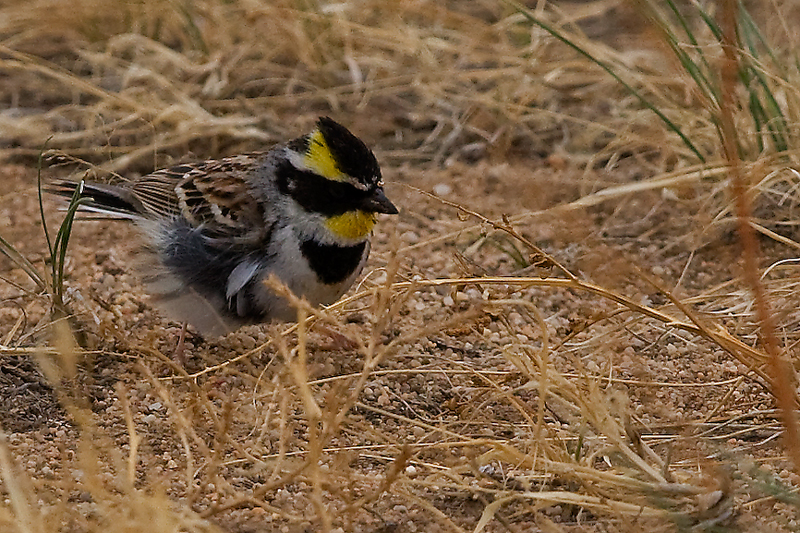
On 18 May we moved on eastwards. The area east of Choibalsan is very flat and treeless but during a brief stop at the border police barracks (we needed to register there as we were entering the sensitive region along the Chinese border) Manfred spotted an unfamiliar bunting. This turned out to be our first Yellow-throated Bunting for the trip, a stunning male. As it had lightly damaged plumage we thought it would be our only observation of this species, which was regarded as accidental. So we asked for permission to take pictures, which was kindly granted. Very likely, these are the first photos ever of this species taken in Mongolia!

Male Yellow-throated Bunting, Menengijn Tal border station,
18 May 2011, © Andreas Buchheim

Male Yellow-throated Bunting in flight, Menengijn Tal
border station, 18 May 2011, © M. Putze

Although we had expected to see large numbers of Mongolian Gazelle during our cruise through Menengijn Tal, the biggest group was just over 200 individuals. Apparently many had left these plains. This was rather surprising as the region seemed to be not overgrazed at all (almost no people live in Menengijn Tal).

Mongolian Gazelle near Choibalsan, May 2011, © M. Putze

Nevertheless, finding a good reed bed (it was the beginning of songbird-migration!) was our task for today so we drove along the chain of lakes south of the plains. Unfortunately they all had dried up and no reed beds were left. So we ended up at a dry lake (already quite close to Ikh Tashgai Nuur) which had much degraded reeds. Here we spent the night.

Much degraded reeds and its degraders, west of
Ikh Tashgai Nuur, May 2011, © A. Buchheim

On May, 19th we finally arrived at birder’s heaven: Ikh Tashgai Nuur. Whether we found our “sought-afters” or not will be reported next… so stay tuned!

July 24, 2011


male Ochre-rumped Bunting, Ikh Tashgai Nuur, © A. Buchheim

This year’s trip brought us to Mongolia’s Far East where we hoped to see some “Eastern Specialties”. But: Statistics first!

duration: 3 weeks for Manfred and Alfons, 4 weeks for Thorsten and 5 weeks for the remaining three.
mileage: 2440 km
species total (5 weeks): 234
first records for Mongolia: 3
second records for Mongolia: 1
days without Common Raven logged: 11 consecutive in the east
days without beer: 2 (but not at Ikh Nart!)

Warm-Up

As our warm-up we went to the Tuul gol (Tuul River) below Songijno Khairkhan Uul where our target species was Azure-winged Magpie. This area has some riparian forest left and the species is regularly (but not always) seen here. In the morning of May, 14th we met Brian Watmough, who is always interested to go out birding and then we drove the 25 km to the west of Ulaanbaatar.

heavily grazed (no understorey) riparian forest below
Songijno Khairkhan Uul, May 2011, © U. Winkler


Hawfinch below Songijno Khairkhan Uul, May 2011, © M. Putze


Black-eared Kite below Songijno Khairkhan Uul,
May 2011, © M. Putze

In the beginning the group saw other birds like Wryneck, Hawfinch and White’s Thrush but then the first blue magpie was spotted. This one turned out to be part of a party of 16 birds which disliked the presence of their bigger relatives allowing us to observe them well for more than 10 minutes.

watching magpies below Songijno Khairkhan Uul,
May 2011, © U. Winkler

dispute between two magpies
(yes, the right one is not a Black Grouse!),
below Songijno Khairkhan Uul, May 2011; © M. Putze

some of the 16 blue ones below
Songijno Khairkhan Uul, May 2011, © Mathias Putze

After having checked the UB-Ponds (disappointing) we returned to the capital by noon and went shopping in the afternoon. The next day saw us on the road to the east …

More to come!

June 24, 2011

Longest twitch in Mongolia 
 
Brian Watmough, 22 June 2011
 
Just completed the longest twitch in Mongolia, 392 kilometres round trip in under 8 hours. Abu [Andreas Buchheim] sent me a text at 12:30 saying there were 3 Siberian Cranes 190 kilometres east of UB, on a small reservoir just a kilometre north of the main road. I realised I had no meetings in the afternoon, so the choice was finishing a report or 3 cranes. Just 5 hours later I was looking at 3 immature Siberian Cranes. My colleagues were bemused that I should make such an effort just to see three birds.


immature Siberian Cranes, c. 60 km E of Baganuur,
22 Jun 2011. © A. Buchheim
 

Siberian Cranes and a Demoiselle Crane, E of Baganuur,
22 Jun 2011. © A. Buchheim

May 25, 2011

Please look out for flagged
shorebirds from Thailand

Over 10,000 waders have been flagged and banded in Thailand by the Department of National Parks, Wildlife and Plants Conservation during 2007 to the present under a national programme for wild bird surveillance. This has resulted in well over 100 foreign resightings of Thai-flagged waders, most from the coasts of E and NE China, with others from Malaysia, Singapore and Indonesia.


cannon-netting shorebirds. © Wicha Narungsri


A handful of Broad-billed Sandpipers. © Pinit Saengkaew

Roughly half of all waders flagged are Greater and Lesser Sand Plovers, for which Thailand holds internationally important wintering populations. As yet, we have yet to receive any resightings of either species in any country to the north of Thailand. Since the race(s) of Lesser Sand Plover that winter in Thailand are in the “atrifrons group” (probably mostly C. m. schaeferi), which breeds in Central Asia [along with Greater Sand Plover], this lack of resightings is understandable, especially given the huge land areas and the paucity of observers in that region.


Lesser Sand Plover © Philip Round/The Wetland Trust


© Pinit Saengkaew


© Pinit Saengkaew

We appeal to observers making birding trips in Mongolia, western China, and other Central Asian countries in the summer months to look carefully at any waders they see in order to search for birds bearing coloured leg-flags. Besides sand plovers there are other shorebirds bearing Thai flags that migrate overland and/or breed in Central Asia (e.g. Common Redshank) that should be looked out for.


leg-flagged Common Redshank, Pak Thale, Thailand. © Christopher Taylor


Department of National Parks ringing team. © Pinit Saengkaew

Thailand uses a black flag placed above a green flag. It is important to record both the shape of the flag (oblong or triangular), and whether the flags are on the right or left leg. (The flags may be both on the tibia, or with the black flag on the tibia and the green flag on the tarsus–precise position of the flags on the leg is not relevant to the resighting).

We should be most grateful for any reports of flagged waders. Resightings of flagged birds may be reported via the Australasian Wader Study Group web-page using the form provided: click here or direct to Ms. Duangrat Phothieng, Department of National Parks Wildlife and Plants Conservation, Bangkok, Thailand: pothieng at hotmail dot com

May 1, 2011

Birding the Gobi, late April

Brian Watmough

It’s the second half of April and the numbers of migrant birds are increasing by the day. I was in Dalanzadgad (DZ) the capital of Umnogobi aimag (South Gobi Province) for a conference but managed to spend a few hours birding with Tumendelger (Tume), local birder and photographer. The trees in the centre of town regularly attract migrants but on early morning visits on 21, 22 and 23 April I only saw Daurian Redstart (2), Black-throated Thrush (4), Brambling (1) and Common Chaffinch (2). On 22nd Tume drove us to DZ Pond, a small lake and marsh at southern edge of town. There were 5 Common Pochard, 3 Tufted Duck and a single female Common Goldeneye on the water, Little Ringed Plover feeding on the shore with flocks of Water Pipit, a Desert Wheatear was singing and two White Wagtails flew overhead. From there we drove to the tree nursery on the south of town where we saw 3 male Daurian Redstart and a Siberian Accentor.

Common Shelduck Gobi, Mongolia, April 2011 © Tumendelger 

The rest of the morning was in meetings but in the afternoon we drove to small salty lakes some 30 km to the east of DZ. Here there was a good variety of waterfowl including 2 Falcated Duck and 3 Whooper Swans. When we returned to DZ around dusk a flock of 14 Black Kites was circling overhead looking for a safe roosting place, and were joined by flock of 40 Daurian Jackdaws and 6 Amur Falcons.

Lake in the Gobi, April 2011 © B. Watmough

Lake in the Gobi, April 2011 © B. Watmough

Species list
Whooper Swan (3), Common Shelduck (25), Ruddy Shelduck (10), Gadwall (5), Falcated Duck (2), Eurasian Wigeon (55), Northern Shoveler, Northern Pintail (10), Common Pochard (30), Tufted Duck (15), Common Goldeneye (10), Grey Heron (3), Great Cormorant (2), Black Kite (20), Hen (Northern) Harrier (1 ringtail), Eurasian Sparrowhawk (1), Northern Goshawk (1), Amur Falcon (6), Eurasian Coot (1), Pied Avocet (18), Northern Lapwing (3), Little Ringed Plover (20), Kentish Plover (4), Green Sandpiper (2), Mongolian Gull (2), Asian Short-toed Lark, Crested Lark (1 by ger), Eurasian Skylark, Horned Lark, Black-throated Thrush (12), Daurian Redstart (6), Northern Wheatear (1), Desert Wheatear (3), Siberian Accentor (1), White Wagtail (2), Water Pipit (30), Brambling (1), Common Chaffinch (2), Mongolian Finch (15).


PS Tume took this picture earlier this month on steppe 70km north of DZ

McQueen's Bustard, Gobi, Mongolia, April 2011 © Tumendelger